The Old State House Still Stands Watch Over State Street
Built in 1713 and surrounded by towers, Boston's oldest public building has survived fire, revolution and redevelopment. It intends to survive the skyscrapers too.
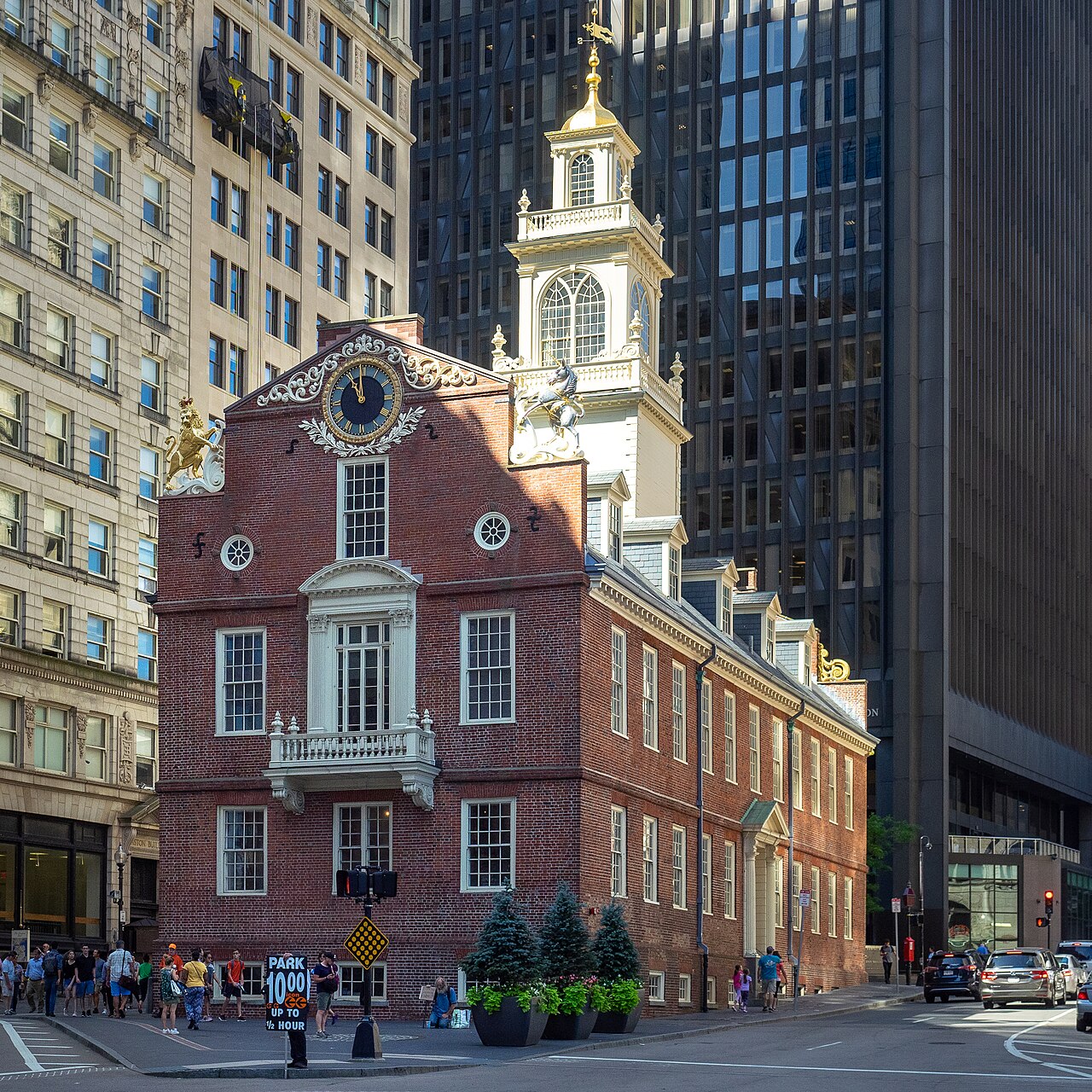
Stand at the head of State Street and look down: glass towers rise on every side, and in the middle of the canyon sits a brick building from 1713, lion and unicorn gleaming on its gable, entirely unbothered. The Old State House is Boston's oldest surviving public building, and it has been outlasting predictions of its irrelevance for three centuries.
The biography is dense. It served as the seat of Massachusetts government through the colonial era and the Revolution — the Declaration of Independence was read from its balcony in July 1776 — and later did time as a city hall, a commercial building and, in one of its stranger chapters, a tenement-era survivor threatened with demolition and even with removal to Chicago before preservationists saved it in the 1880s.
Today it operates as a museum, run by Revolutionary Spaces, on the Freedom Trail's busiest stretch. A subway station hums beneath it — State station, where the Blue and Orange lines cross — which makes it perhaps the only museum in America with rapid transit in the basement and a massacre site, the Boston Massacre of 1770, marked in cobblestones outside its doors.
What keeps the building essential is not nostalgia; it is scale. Against the towers, the Old State House reminds the Financial District that Boston was a city of consequence when its tallest structure was a meeting house, and that public buildings can anchor a street for three hundred years if a city decides they matter.
Development will keep rising around it. The little brick survivor at the head of State Street has heard that before — in 1713, in 1881 and in every decade since — and it is still standing watch.